Fairy Yardmother Landscape Design

by Kathy Oberg, Landscape Designer, Central Coast CA.
FairyYardmother[at]gmail[dot]com

Thank you for visiting my site. I enjoy bringing you pictures of gardens, plants, and ideas from sunny California. I love sharing after-photos that show how my landscape plans, plant lists and layouts come to life.
As a designer, I use plants to create drama, provide color and form, and compliment the architectural style of your home.
I strive to provide a buffer from sun, street, and neighbors while still fostering connections.
Inspired plant choices and site layout can make any space a success.
I am a Certified Watershed Wise Professional, with techniques to improve soil health and keep more water on your property.
I can help you makeover your patio, paths, planting areas, or entire property. I will consult with you, choose a look you love, and compose a plan and plant list to update your landscape, re-using what you already have wherever we can.
Each project is different because it is about making your space really shine.


Showing posts with label Broken Concrete. Show all posts

Monday, October 6, 2014

Broken Concrete/Urbanite Pathways


Broken Concrete is also known as Urbanite. I love using the material to build pathways and walls. The cement industry produces a lot of Carbon Dioxide. Re-using existing concrete is an environmentally-friendly option for paving needs, and it can look awesome!

This pathway looks a lot like natural stone in person. It is laid permanently in mortar.


Alternatively pathways can be laid in sand or decomposed granite, or broken concrete pavers can be surrounded with pea gravel or larger stones. All of these options create permeable pathways, which are more environmentally friendly than using cement between joints. The material will look different depending on how it's installed.

Many people use gravel for pathways, and even though gravel can be very pretty and appropriate for certain situations, it is not kid friendly for scooters and trikes, etc. Here's a recent project where I suggested we replace a gravel pathway and patio with Broken Concrete in Decomposed Granite. Now the children of the house can ride their tricycles along this path.

BEFORE

AFTER


Broken concrete or any other paving material is usually more successful when installed by professionals. Laying the varied shapes in a pleasant pattern and getting a perfect level on each piece can be quite challenging for the inexperienced person. It also helps to have a pro pick out the broken concrete to make sure it is sound. Not all old concrete is worth re-using.
Here is a broken concrete pathway that serves aesthetically as a dry stream bed. The client wanted to use gravel with the broken concrete, and that is fine for this application because this is a pathway to the side of the house, and is not in constant use. It's more of a focal point from the path to the front door. The gravel gives the look she wanted, a nice contrast to the plantings in this former lawn area. However if this were a main pathway -- to the front door, for instance -- I would not suggest gravel because it can make a path along a slope like this a bit slippery. For a slope, you might want to install the broken concrete in cement. The first photo shows one way of doing that.


Wednesday, May 21, 2014

From Front Lawn to Low-Maintenance Front Yard

On this project, I designed a new pathway to improve the flow from the driveway and sidewalk to the front door of the home. We opened up access to the beautiful front archway for a more direct path to the front door. We planted some wonderful drought-tolerant plants, and helped the homeowner get her lawn-removal rebate.

BEFORE: Front Lawn with no path to front door

AFTER: Pathway to Door and New Plantings
Access to the front door through the previously hidden archway makes the property more inviting, brings out the Spanish architecture, and improves access from the sidewalk and driveway. The plant material will fill in over the next 2 to 3 years, giving a lot of privacy from the sidewalk and street.

AFTER: CA Native, Carex Pansa in center of DG circle


We wanted to mix some tough tropicals with ornamental grasses and succulents. It's a fun combination that wouldn't work many places outside of SoCal! As the plants grow in, the homeowner will have a beautiful, yet private view from her front windows, and a nice buffer from the street.

Monday, March 17, 2014

Eagle Rock Patio


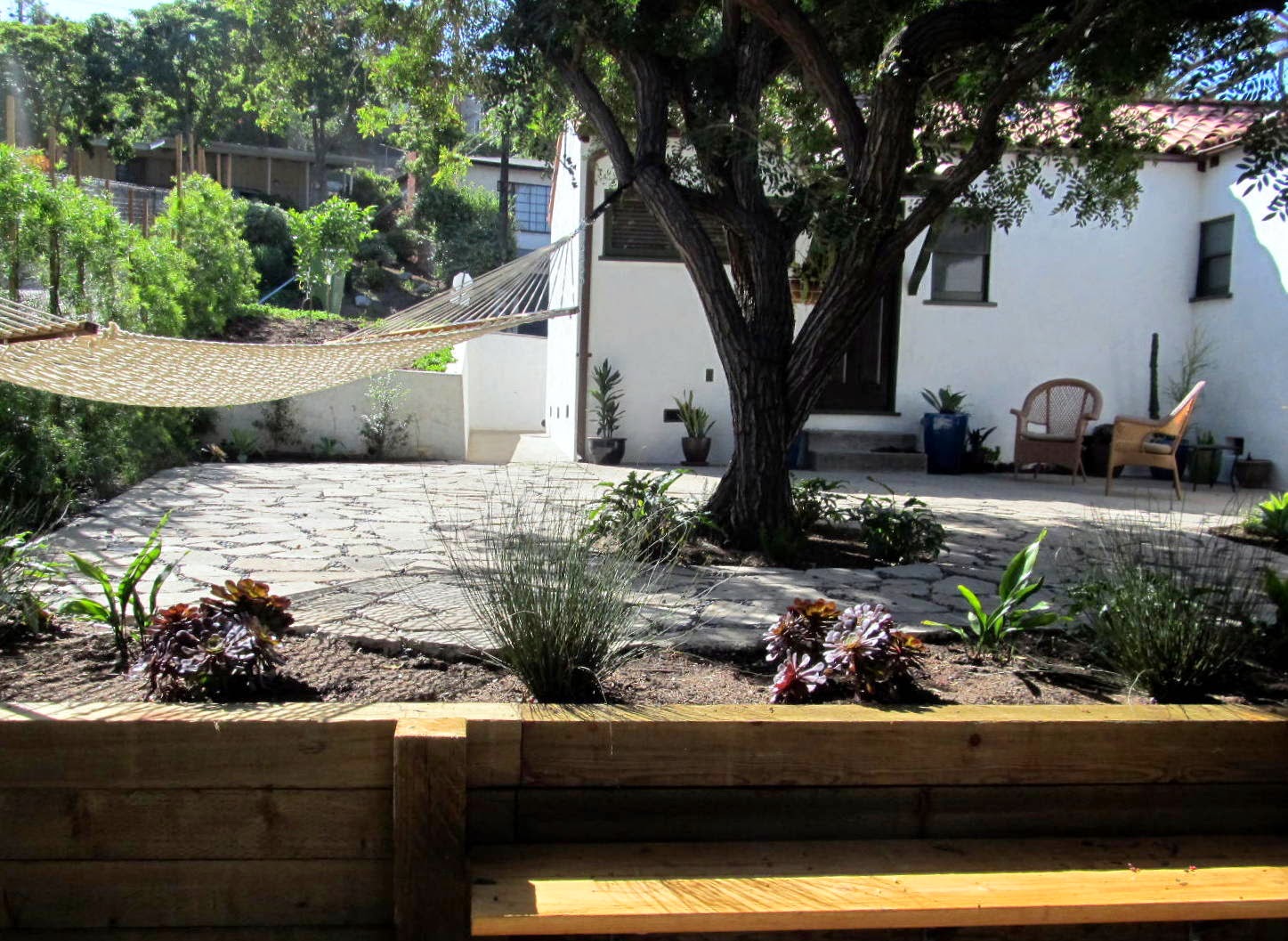
AFTER: The Lower Area of the yard is now an entertaining area
BEFORE: Lower Area


BEFORE: Existing Patio not easy to access


This project entailed a few Design challenges. The house was recently purchased. In the client's only private yard space he had a small patio that was easily accessible from the bedroom only (door on left under overhang), but not from the kitchen nor any other room of the house.


Turf was planted on a sloping area adjacent to the existing patio when the house was put on the market. But this lawn was not practical. The shady area under a Pepper Tree was often muddy and difficult to traverse.

We removed the lawn, leveled the slope, and used broken concrete pieces to extend the living area. The client benefited from a turf removal rebate.


AFTER: Extended Patio, Better Access from Kitchen

BEFORE: From Kitchen to Patio, Muddy Slope
AFTER: Steps from Kitchen to Patio


AFTER:  Same Steps from Kitchen and Lower Area to Upper Patio
BEFORE: Slope with no pathway
AFTER: Enlarged Level Patio with Steps 
BEFORE: Under-utilized Space


AFTER: Retaining Wall, Level Upper Area

Now the client is spending every weekend in his new yard! The retaining wall allowed us to make best use of the upper space, creating a level extension of the patio, and greatly improving the flow between the upper and lower levels of the yard, and the house.

I chose many tough, shade-tolerant plants for this project because of the tree cover. We also removed very old Cypress, and planted a new hedge all along the property line. Within a couple years, the plant material will be lush and wonderfully soft, with some sculptural elements like the Agave, Chondropetalum, and Aeonium.