Fairy Yardmother Landscape Design

by Kathy Oberg, Landscape Designer, Central Coast CA.
FairyYardmother[at]gmail[dot]com

Thank you for visiting my site. I enjoy bringing you pictures of gardens, plants, and ideas from sunny California. I love sharing after-photos that show how my landscape plans, plant lists and layouts come to life.
As a designer, I use plants to create drama, provide color and form, and compliment the architectural style of your home.
I strive to provide a buffer from sun, street, and neighbors while still fostering connections.
Inspired plant choices and site layout can make any space a success.
I am a Certified Watershed Wise Professional, with techniques to improve soil health and keep more water on your property.
I can help you makeover your patio, paths, planting areas, or entire property. I will consult with you, choose a look you love, and compose a plan and plant list to update your landscape, re-using what you already have wherever we can.
Each project is different because it is about making your space really shine.


Showing posts with label Plants. Show all posts

Tuesday, January 31, 2012

Dry Creek Bed


If you have a large yard with some changes in elevation, and you want a natural feel, a dry creek bed is a lovely way to give flow and structure to your space.

Oaks or Sycamores, which need a lot of room, are potential trees to surround a dry creek bed. Woodland plants, grasses, sedges, or rush-like plants, and California natives like Ceanothus and Mimulus all help to create a beautiful natural-looking space. Succulents also find a place here. If you have a sitting area from which you can view your creek, you will really enjoy it.


I just designed a dry creek planted with some of my favorite California native plants, including Mimulus, Arctostaphylos and Ceanothus. I also used Chondropetalum tecorum among the boulders, a South African rush-like plant which is drought-tolerant, but looks like it belongs along a creek or stream.


After we removed the lawn, we started placing the boulders.

Before


During

We sunk the boulders into the earth a few inches, so they look like they belong. We added Mexican River pebbles around and between the river rock boulders, and added plants and mulch. Kids love walking on the rocks! Natives do well planted small, and we had the roots of a mature Sycamore to worry about, so we planted very small plants.

During

Newly Planted After
Boulder vignette ties in with creek


Tuesday, October 4, 2011

Muhlenbergia rigens Deer Grass

Deer Grass at The Getty Center

Deer Grass is a wonderful California Native ornamental grass for the garden. It has a lovely fountain-like shape, and blonde plumes. It is not too big, nor is it invasive. It looks wonderful massed.
I just designed a planting of 100 of these grasses along a stretch of Glendale Boulevard in Los Angeles as part of a community beautification project. Pictures to come!

Friday, July 1, 2011

Ornamental Grasses

Grasses are masters of motion and light in the garden.

They are tough, drought-tolerant, and take sun or part shade. They are gorgeous in drifts, and especially lovely planted where the sun will shine through them at the beginning or end of the day.

It is important to give grasses the room they need because they look best when they are full. I have seen large grasses planted against a sidewalk so that they needed pruning once a month or more, and to me, they look terrible! Their beauty relies upon that wonderful fountain shape they achieve when they are allowed to grow to their full size. They should only be cut back, usually to the ground, once or twice a year when they begin to look dry and ragged.


Grasses offer a wonderful way to create a soothing palette of greens, with texture and motion to give interest.
Here are a couple examples of grasses planted along a "stream bed" of river rock at the Skirball Center in Los Angeles.

Tuesday, May 31, 2011

Roses

Descanso Gardens

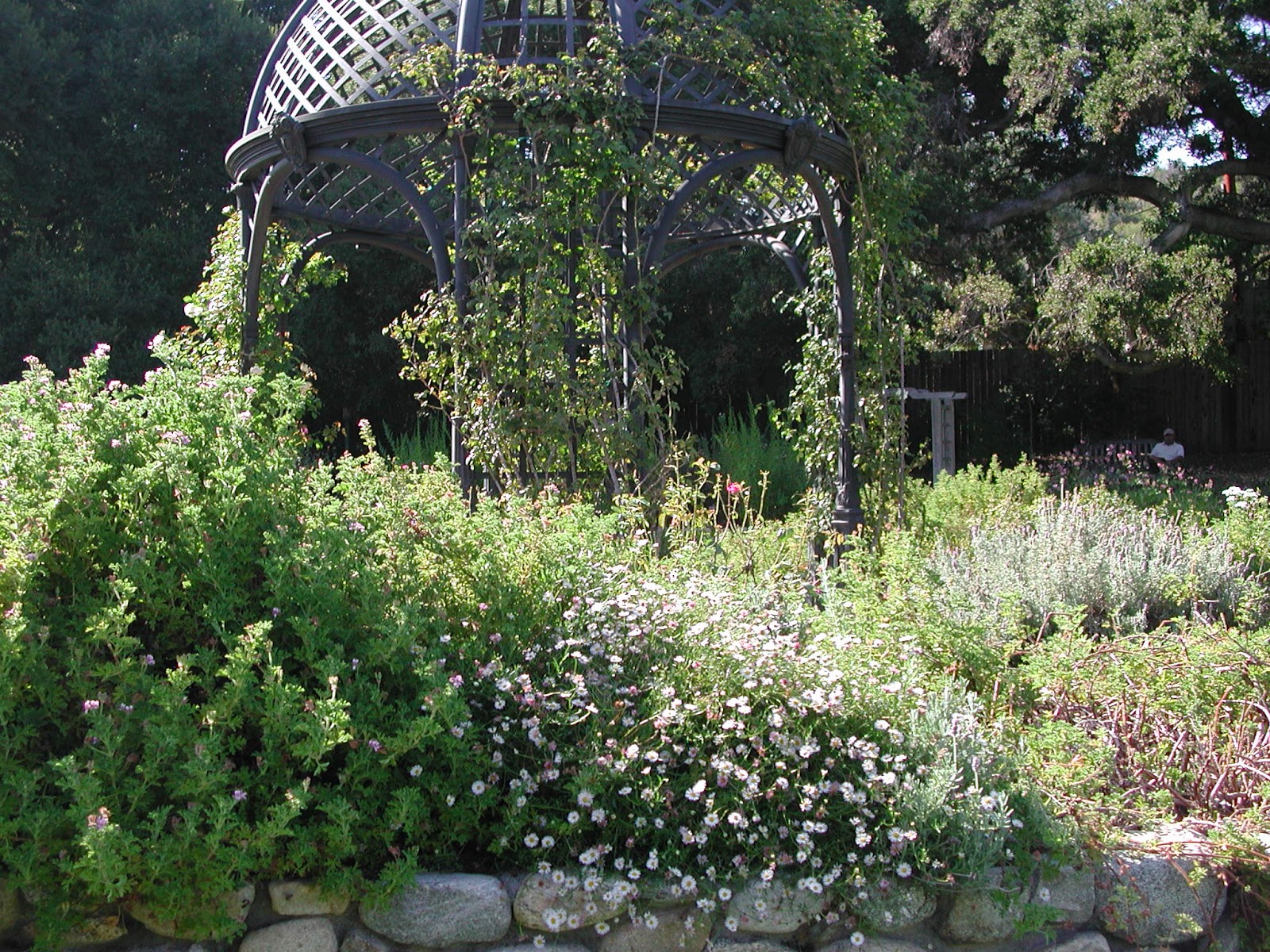
Rose Gardens, especially those made up exclusively of roses, have gone out of style, but mixing roses with perennials and herbaceous or flowering ground covers to create a complex palette of flowers and foliage is a wonderful and less labor intensive alternative to the old-fashioned rose garden . The "Rose Garden" at Descanso Gardens takes this tact, and it is a lovely way to enjoy roses as part of a mediterranean garden.


Iceberg Rose


Roses are easier to grow than you may think. Time has taught me some tricks with roses, and I take great pride in that first flush of flowers in March and April, knowing that I'm growing roses without chemicals, and, surprisingly, with very little water. This Iceberg Rose had passers-by stopping to enjoy, and other than dead-heading, it's not much work!


Some secrets to growing care-free roses include:
  • Full Sun
  • Loamy Soil 
  • Air circulation (enough room)
  • Mulch with a fine mulch
  • Side dress with compost
  • Clean up fallen leaves and petals
  • Choose varieties that are disease resistant and are recommended for your area
  • Prune correctly (not too dramatically) in late Fall
  • Water deeply and rarely once established

These principles have allowed me to grow roses very successfully without fertilizers, pesticides, or a lot of water. If you have light, loamy soil and full sun, you should try growing a rose bush, and see how it does. Roses can't be beat for scent, color, and beauty. And they are a wonderful cut flower, of course.
Iceberg is usually a slam dunk. Sally Holmes is a gorgeous climber. Sunset has lists of roses for different areas, that can be very helpful. Roses add so much to the Spring, Summer, and Fall garden, it's a shame not to grow them if you have the right conditions to do so easily. By mixing roses with other plants, they can find a place in a contemporary garden, and give us so much pleasure for so little care.

Sunday, May 15, 2011

Lavender

Lavender is one of those plants that makes one believe in a higher power! I think I've found the very prettiest Lavender of all: Lavender Provence.
Lavender likes deep watering once or twice a week while getting established -- maybe more in the first month depending on the weather and the size of the transplant. The fewer roots, and the higher the temps, the more often must one water newly planted plants; sometimes even daily for the first couple weeks.
Once established, Lavender needs very little water. It is a classic Mediterranean selection that goes well with other perennials with similar needs: Salvias, Rosemary, Ornamental Grasses, Bearded Iris, Roses, and California Natives like Ceanothus.


Lavenders can get quite large, especially the somewhat sprawling French toothed-leaf Lavenders. They need to be trimmed regularly (2 to 3 times a year) to remove old flowers and be kept somewhat compact. It is thought that they live longer with regular, light pruning.


Wednesday, May 4, 2011

DIY Bird Bath Thrift Store Edition

A recent client, who was a lot of fun to work with, wanted the feel of an English Cottage Garden around her patio, so I brought in some Apple Blossom Penstemons, White Salvia greggii, Yarrow, Bearded Iris, Heuchera and Mallow. This spot is a bit difficult because much of it gets the Western sun in the afternoon, especially in the Spring and Summer, but more shade during the winter. The plants I chose can take sun and part shade, and so far they are doing quite well.

I saw this purple glass bowl at a thrift store along with the glass and metal candlestick I used as a stand, and created this bird bath to go with the planting. I replaced the metal rod in the center of the base with a longer, thicker one, and was able to sink that into the soil about 2 feet.

Friday, April 8, 2011

Flax and Fescue

This combination really struck me. I see these plants all the time, but I don't think I've ever seen this particular Phormium mixed with Fescue in such a dramatic yet simple planting. The way the gray-greens play together is wonderful, and the contrast in texture makes the Phormium feel so soft.
The scale of the planting is large for a rather small front yard, but I think it works. It's striking, but it's not for everyone. The little Agave on the left is also nice in the composition, but it may take over the space when it grows up!

Thursday, April 7, 2011

Catmint: Nepeta "Walker's Low"


I love this little herbaceous ground cover, Nepeta faassenii. It has pretty, aromatic, gray-green leaves and blue flowers. It does not necessarily stay low, but can grow to 2 feet high. Sheer to keep lower.
If you plant from 4" pots in Spring, it will take off very quickly. Plant about 2 feet apart. It looks as at home in a semi-dry mediterranean garden as it does around roses.

Friday, March 4, 2011

Seeds


Planting from seed is a wonderful adventure, full of anticipation, failures, triumphs and surprises!
I decided to plant some seeds in our vegetable garden in February. Last chance for a few sugar snap peas, I hadn't managed to put in earlier. And last chance for a bit more lettuce and spring mix, which never does as well as we get into late Spring and Summer. Late Winter is a good time for carrots, chard, beets, and turnips. The last two, I am trying for the first time.


I've had very good luck with carrots, maybe because we are not far from the LA river, and our soil is silty. My mother-in-law was a prolific gardener, but could never successfully grow carrots, so I feel blessed! There is something so dramatic about pulling a big carrot out of your own tended soil! For one thing, you never quite know how big and well-shaped a root vegetable will be until you pull it out of the ground. The seeds are known to take a while to germinate, and just when I almost lost hope this time, there they were! It took about 3 weeks.

Spring mix seed was casually thrown 
I began to muse about seeds and seedlings. Planting seeds is a wonderful act from many perspectives. It ties us to all the human beings who have harvested seeds from a plant in order to have that plant where they can tend it and reap its harvest.
Planting seeds is an act of hope, no doubt! It is a plan for the future, a hope that all will go well, and knowledge that much of the success is completely out of our hands!
When I first created my raised beds, I could chuck some seeds in, and for better or worse, they'd pretty much come up, grow and give me fruit (or veggies!). But then the skunks and raccoons figured out what I was doing, and started digging for worms, grubs, etc. So my seedlings were constantly disturbed, and my success rate plummeted.
Looking at one of my tomato cages recently, I realized that a very cheap solution was to buy some rolls of wire, and put them over the beds temporarily while things get established. I've begun the process, and it's working! Will customize the wire for each bed, and be able to use it year after year.
Some of the plants I've grown from seed that have been super easy:
Alyssum, California Poppy, Lupine, Spring Lettuce/Meslun Mix, Nasturtium, and Borage.

Tuesday, January 25, 2011

Leucadendron

I LOVE this plant. Have to find a place to use it on a job or in my own yard. Love the structure, the red stems. It's beautiful in flower arrangements, too. I thought it was Australian. It's in the Protea family. But I read that it's actually South African. Perfect for our mediterranean climate. It gets to 5 or 6 feet tall and almost as wide.

Sunday, November 28, 2010

Grass-like Ground Covers

Mondo grass and Lilyturf (also below)
A recent trip to the Getty Center in Los Angeles had me examining ground covers. Here are some examples of plants that can cover the soil under trees, on slopes, and along walkways or swaths of grass -- most of them will not handle foot traffic, but they are wonderful for creating lushness and texture, while preserving a view. They take much less maintenance than traditional lawn grass.


Love the contrasting colors

Society Garlic carpets a slope under Crape Myrtles (not so good near primary sitting areas because it gives off an odor). I love the texture and color here. The garlic creates waves of softness and picks up the gray of the tree trunks.

Deer Grass and Dymondia border turf grass. Interesting use of Dymondia. There's a bit of tension between the greens and grays here, but I like it.

Thursday, September 16, 2010

Plants -- Combinations of Textures and Colors

When I look at garden compositions, I find that I am most drawn in by contrasting forms and color. Probably the most common contrasts in form include rounded leaves combined with long, swordlike leaves, and round or swordlike leaves combined with lacy elements. Rounded vs long or lacy can also be seen in flowers. Here are some examples:


I am also struck by plants of dissimilar form, that echo the same color.
Here, a few of the paddles of the cactus behind (rounded), are the same purple as the Echeveria (rosette with long flower stalks).


And here, below, chalky white is seen in both the rosette of the Echeveria (round) and the lacy and long form of the Teucrium. To me, planting the right wonderfully dissimilar forms together tends to illustrate that the whole is often greater than its parts.


And then the alternative: strikingly similar forms in strongly contrasting colors. This can be very successful, but I do think that if the planting is going to be large and continuous, there needs to be a contrasting leaf shape present. Otherwise it gets boring! Notice the cement globe in the next photo acts as contrasting element. Here are two examples where similar forms in different colors work well together.


In all of these examples, some element ties the plants together. Maybe their colors are similar or complimentary while their form is radically different, or vice versa. There is usually a common trait shared, and often that is what allows the contrasting traits to pop. But sometimes the common trait is the thing we find surprising, as in the paddles of the cactus that match the purple Echeveria.
This discussion just begins to scratch the surface of the use of form and color.

Friday, September 10, 2010

Fall Flowers


It's starting to feel like Fall, and there are certain plants and flowers that always make me think of Autumn. In Southern California, the seasons are a little flat because vegetables grow, leaves fall and flowers bloom at all times of year here. But Autumn still has a distinct feel to it.


The light changes, the sun starts to angle. There's a slight chill in the air, especially by Halloween.


I love seeing the afternoon sun shining through the plumes of Miscanthus. It gives such a warm golden glow.


The Light coming through the Miscanthus reminds me of Fall, but the white-gray of the Lamb's Ear makes me think of snow!


There's nothing like sunflowers. They never fail to make me smile.


Echinacea also reminds me of Fall for some reason, despite it's being so bright and cheery.  Most things that make me think of Autumn are darker and earthier. It looks great with Rudbeckia even though pink and yellow are not always friendly companions. Maybe it's because their form is similar.

The Fall Equinox is on the evening of September 22 this year. Happy Fall!

Tuesday, September 7, 2010

Oaks

This Oak is est. at 250 yrs old


Among California's treasures are the native Oaks. They are wise old souls of the hot, dry summers here. They are such a part of the Southern California Landscape, it's easy to take them for granted.
Anyone lucky enough to have a mature Oak Tree on their property needs to be aware that not everything plays well with Oaks. One needs to choose companion plants carefully. Ones that don't need summer water and that don't succumb to Oak Root Fungus are preferred.


Often Oaks are seen in Summer and Fall with dry, brown grasses covering the ground underneath them, or their natural mulch of small stiff leaves and acorns.
These are Coast Live Oaks, Quercus agrifolia.


Good understory companions include:

Arctostaphylus
Carex
Ceanothus
Eriogonum
Rhamnus
Salvia
Zauschneria


Looking up into the branches of an old oak, I almost expect to see fairies! They have such a magical and powerful presence. These Oaks are located in Descanso Gardens. Another one of my favorite places to be surrounded by Oaks? Topanga Canyon State Park. There's really nothing else like being among the Oaks!

Sunday, August 8, 2010

Bamboo

Phyllostachys nigra
I've come to the conclusion that Phyllostachys nigra, Black Bamboo, is one of the most beautiful plants in the world. It has lovely, lacy foliage, and culms which turn black with age. It's not aggressively invasive like golden bamboo, but it is also a runner. Running bamboos may have a bad rep, but they form beautiful groves and hedges exactly because of their habit.

r
nigra


There are two general kinds of Bamboo: The runners can pop up many feet from the original plant, and eventually form a fairly large open grove if not curbed. Runners are wonderful in long narrow spaces, along walls or fences for example, though they are healthier if the narrow space is at least 3 feet wide. There is a product called rhizome barrier that can curb them, and it's best to install it before planting.

Running


Clumping bamboo has a completely different habit -- it forms a larger and larger roundish clump, and it is not as suitable for planting in long narrow spaces. Clumping bamboo is not really invasive at all. It stays in a clump, and does not travel all over one's yard, but the clump can tend to grow quite large, and some clumping bamboo is giant!

Clumping "Alphonse Carr"

Clump

Monday, August 2, 2010

Salvias


Salvia Waverly
Salvia Clevelandii
Salvias are the greatest plants. There are a million different kinds, and many of them flower most of the year in SoCal. They need to be cut back just once or twice a year. They are drought-tolerant, and they attract loads of hummingbirds and bumblebees.

The only thing some people might not like about them is they are a bit wild and messy looking, and some grow quite large -- 5 foot by 5 foot or so.


Some of my favorites include:

Salvia Greggii
Salvia clevelandii
Salvia leucantha
Salvia microphylla "Hot Lips"
Salvia officinalis

I've noticed that the bumblebees seem to cut into the flower where it's connected to the stem -- I'll try to get a picture some time!